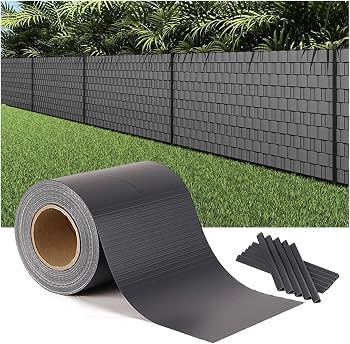
Product Details
Place of Origin: Zhejiang, China
Brand Name: Yitex
Certification: ISO9001; BSCI:reach
Payment & Shipping Terms
Minimum Order Quantity: 300 rolls
Price: $5.7/rolls 500 rolls $5.6/rolls 1000-4000 rolls
Packaging Details: 4roll/carton
Delivery Time: 45days
Payment Terms: T/T
Supply Ability: 1000 Roll/Rolls per day
Application: |
Garden; House;Yard |
Color: |
Grey,green,black... |
Thickness: |
450gsm |
Size: |
0.19*35m |
Thickness: |
0.4mm |
Clips: |
20 |
Packing: |
4rolls/carton |
MOQ: |
500pcs |
Application: |
Garden; House;Yard |
Color: |
Grey,green,black... |
Thickness: |
450gsm |
Size: |
0.19*35m |
Thickness: |
0.4mm |
Clips: |
20 |
Packing: |
4rolls/carton |
MOQ: |
500pcs |
A dense, flexible PVC strip that weaves horizontally through chain-link and wire mesh to block sight lines and cut wind pass-through. Extruded on our own line with width and thickness monitored during production, so the strip that arrives at the end of a 35 m roll matches the one at the start — which is what stops a finished fence looking wavy.
Most enquiries we get are a variation of one question: will this make my fence private? The honest answer depends on the fence you already have, so this section is written to settle it before you order rather than after.
The strip passes through the mesh and is held by the wire itself. No clips, no drilling, no posts. That is also why it flexes with the fence instead of loading it — the reason a 0.4 mm strip behaves better in wind than a rigid PVC panel of the same coverage.
Coverage is close to total when strips are laid edge to edge, but this is screening, not a solid wall. Expect full privacy at eye level on a 1.8 m fence; expect light to pass at the edges and at mesh distortions.
Strips pull back out of the mesh and can be reinstalled elsewhere. This is what makes it the usual choice for rented property, seasonal plots and construction-site screening.
A thickness or width figure without a tolerance is a marketing number. These are the nominal values and the production tolerance we hold on the line, so your estimator can plan against them.
The 6.65 m² figure is theoretical. In practice a woven strip loses a little coverage where it follows the mesh, and almost every run needs an overlap at the ends. Enter your fence below and the allowance is applied for you.
Calculation: area = length × height; rolls = ⌈area × (1 + allowance) ÷ 6.65⌉. Rows = ⌈height ÷ strip width⌉. Results are a planning estimate — send us your dimensions and mesh aperture and we confirm against the actual roll before you commit.
Two suppliers can both quote 0.4 mm × 19 cm and deliver very different rolls. The difference is what happens between the die and the winder, so here is what we monitor and why each check exists.
Thickness is read continuously during extrusion and width checked against the drawing at set intervals. A drift is corrected on the line, not discovered at the customer end. The practical result: no thin sections that tear at a mesh contact point, no width steps that show as a visible seam.
Flexibility comes from the compound, not from making the strip thinner. We keep the formulation fixed per grade so the strip you reorder in six months weaves and hangs the same as the first delivery — a detail that matters for repeat trade orders.
Standard grade is formulated for normal outdoor exposure. For high-sunlight regions — southern Europe, the Middle East, Australia — order the UV-stabilised grade. We state this as an option rather than printing a universal "10-year" promise on every roll.
RAL 6005 Moss Green is matched against the RAL card. For projects that reorder at intervals, ask for a retained sample from your first batch so later runs can be compared against it.
Green fence screening is not one colour. Specifying a RAL number removes the ambiguity between "green", "forest green" and "moss green" — and it is the number your client, contractor or planning document will recognise.
Screen colours differ by device. For colour-critical orders we send a physical sample or a retained chip before production — ask for it at quotation stage.
Three products are routinely quoted for the same job. They are not interchangeable, and picking the wrong one is the most expensive mistake in this category.
Tool-free, but not thought-free. Nearly every complaint about uneven screening traces back to one of these four steps.
Set the first strip along the top or bottom wire and check it against a string line. Every later row references it.
Pass over one wire, under the next. Even tension along the run matters more than speed.
Use the strip width as the gauge. Small spacing errors accumulate visibly over 20 m.
Overlap adjacent strips by 2 cm so shrinking or movement never opens a gap. Trim only after the run is complete.
Reusable by design: pull the strip back through the mesh in reverse order. Undamaged strips reinstall in the same or a new location — the reason this product is standard on temporary sites and rented plots.
A UV lifetime figure we have not tested for your climate, a "10-year warranty" on a standard grade, or a fire rating that does not exist for this product. If a buyer needs a document we do not hold, we say so — a missing certificate is a smaller problem than a false one at customs.
Custom roll lengths, slit widths, alternative RAL colours and printed core labels are available on project volume. Send the specification and the site country, and we reply with tolerance, lead time and freight to your postcode.